
Water Pressure Regulator Installation in Lake Stevens, WA
High water pressure silently destroys plumbing. Pressures we see in Lake Stevens homes often hit 90 to 120 PSI — well above the 80 PSI code limit — wearing out faucets, toilets, supply hoses, and water heaters years early. Eby Plumbing installs pressure reducing valves (PRVs) and expansion tanks.
If your pipes bang when the washing machine fills, your toilets run for no reason, or a plumber once measured your pressure and just shook his head — you probably need a pressure reducing valve. Eby Plumbing installs and replaces PRVs across Lake Stevens, and pairs them with expansion tanks so the fix is complete, not half done.
What are the signs my water pressure is too high?
Loud thuds when a faucet or appliance valve shuts off fast. High pressure makes the shock wave worse and can crack fittings over time.
High pressure forces water past fill valves. If you keep replacing flappers, pressure may be the real problem.
Cartridges and washers rated for 60 PSI give up early at 100+ PSI.
Rubber washing-machine and dishwasher hoses are the weak link — a burst hose floods a laundry room in minutes.
The temperature and pressure relief valve weeps when thermal expansion has nowhere to go — classic with no expansion tank.
The definitive test. Screw a pressure gauge on the hose bibb, open it fully with everything else off, and read the static pressure.
Why is pressure high here? Much of Lake Stevens is served at street pressures designed for fire flow and elevation changes. Homes at lower elevations — near the lake, in North Cove, along the flats toward Everett — get the highest static pressure. Pressures we see at the hose bibb commonly land between 90 and 120 PSI, nearly double what your fixtures are designed for.
What is a PRV and how does it work?
A pressure reducing valve (also called a pressure regulator) is a bell-shaped brass valve installed on your main water line where it enters the house. Inside, a spring and diaphragm throttle the incoming street pressure down to a safe, steady household pressure — usually set between 50 and 60 PSI. It works automatically and continuously, whether one faucet is running or the whole house is.
Plumbing code requires a PRV when static pressure exceeds 80 PSI. This is not a suggestion — sustained high pressure voids fixture warranties, and insurance adjusters know it. If your home was built without one, or the original valve has worn out, installing a PRV is one of the highest-value plumbing upgrades you can make.
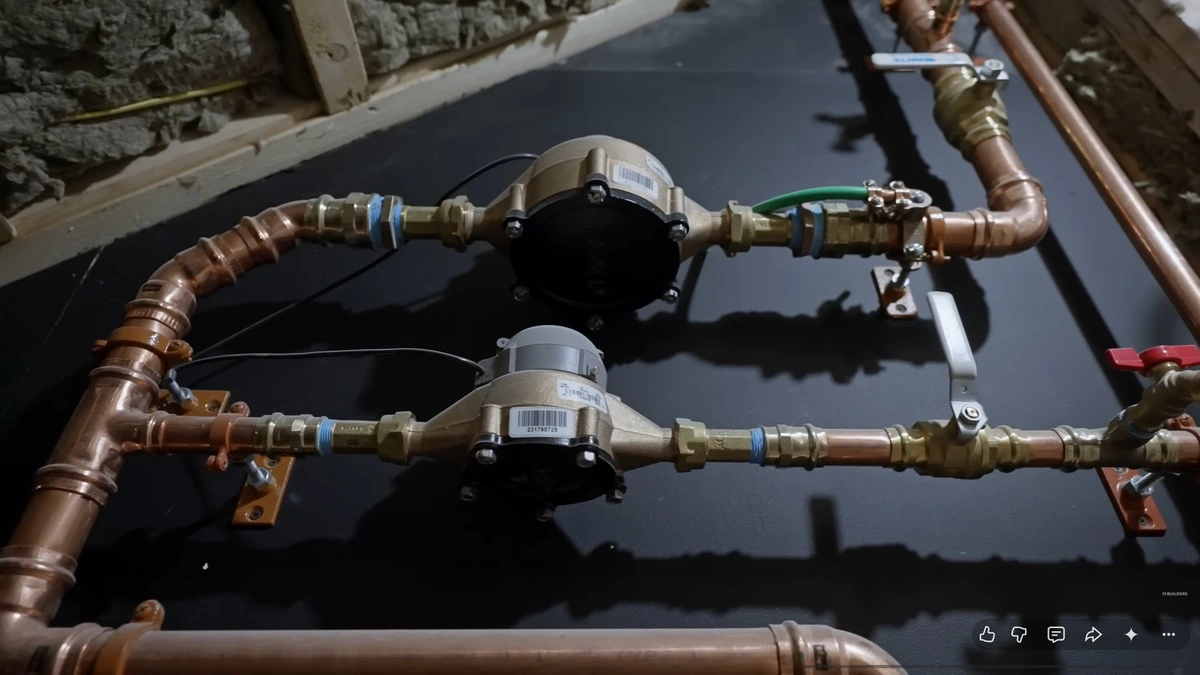
A PRV installs on the main water line where it enters the home — like this copper main — with isolation valves on both sides so it can be serviced without shutting off the street.
Why do I need an expansion tank with a PRV?
Here is the part many quotes skip. A PRV creates a closed plumbing system: water can no longer push back out into the street main. When your water heater fires, the heated water expands — and with nowhere to go, pressure spikes throughout the house. The symptom is a water heater relief valve that drips after every heating cycle, and over time the cycling fatigues the tank and the PRV itself.
The fix is a thermal expansion tank: a small tank with a rubber bladder and an air charge, mounted near the water heater. It absorbs the expanded volume and keeps system pressure steady. Code requires one on closed systems, and any honest PRV quote includes it. If a bid for a PRV does not mention an expansion tank, the bid is incomplete.
How much does pressure regulator installation cost in Lake Stevens, WA?
| Job | Notes |
|---|---|
| New PRV installation | Valve, isolation valves, and labor on the main line |
| PRV + expansion tank | The complete, code-correct install — this is what we recommend |
| PRV replacement (existing valve) | Swap-out where unions and shutoffs already exist |
| Expansion tank alone | For homes that have a PRV but never got the tank |
| Main shutoff valve replacement | Often needed — old gate valves freeze open and must be cut out |
| Pressure test and adjustment | Diagnostic visit: gauge readings, valve check, pressure set |
Scope depends on pipe material (copper, PEX, or galvanized), access to the main line, and whether the main shutoff needs replacement — confirmed with a written quote before work begins.
Where does the PRV go, and can I adjust it myself?
The PRV goes on the main water line just inside the house (or in a meter box in some installations), with a shutoff valve on each side so it can be serviced without digging up the street. Most PRVs have an adjustment bolt under a cap nut — turning it counterclockwise lowers the set pressure. A homeowner with a hose-bibb gauge can fine-tune the setting.
But adjustment has limits. If the valve is over 10 years old, corroded, or will not hold a setting, you are adjusting a worn-out part. And if a PRV fails, it can fail closed — meaning no water to the whole house until it is replaced. When in doubt, have it checked before it becomes a no-water morning.
How long do pressure reducing valves last?
A quality PRV lasts 10 to 15 years. Lake Stevens water is soft — about 73 ppm hardness per the Snohomish County PUD water-quality report — so mineral scale is rarely what kills valves here. Springs fatigue and diaphragms wear; the valve gradually stops holding its set pressure, and readings creep upward or swing wildly. If your PRV is over a decade old and your gauge numbers are climbing, replacement is preventive maintenance, not an upsell.
High pressure and old pipes?
Galvanized lines plus 100 PSI is a burst waiting to happen. See our repiping services page.
Know the warning signs
Our signs you need a plumber guide covers pressure symptoms and more.
Nearby service areas
We install PRVs across the region — Snohomish and Granite Falls included.
Last updated: October 2026
Frequently asked questions
What is normal water pressure for a house in Lake Stevens, WA?
Ideal residential water pressure is 50 to 60 PSI. Plumbing code requires a pressure reducing valve when static pressure exceeds 80 PSI. Pressures we see in Lake Stevens homes often run 90 to 120 PSI at the hose bibb, especially in lower-elevation neighborhoods near the lake. Sustained pressure above 80 PSI shortens the life of fixtures, supply lines, and appliances.
Where is a pressure regulator installed?
On the main water line where it enters the house, just past the main shutoff. We cut in the pressure reducing valve, add a thermal expansion tank at the water heater if needed, and set the house pressure to a safe range — then verify it with a gauge.
Why do I need an expansion tank with a PRV?
A PRV creates a closed plumbing system: water heated by your water heater has nowhere to expand back into the street main. Without an expansion tank, thermal expansion spikes pressure and forces the water heater's temperature and pressure relief valve to drip. An expansion tank absorbs that extra volume and protects the heater, the PRV, and your fixtures.
What are the signs my water pressure is too high?
Banging pipes when faucets shut off, toilets that run or phantom-flush, dripping faucets on fairly new fixtures, washing machine or dishwasher supply hoses that bulge or burst, and water heater relief valves that drip. The definitive check is a pressure gauge on the hose bibb: sustained readings above 80 PSI mean you need a regulator.
Can I adjust a pressure reducing valve myself?
Most PRVs have an adjustment bolt under a cap nut, and a homeowner can turn it down slightly with a pressure gauge on a hose bibb to verify. But if the valve is over 10 years old, corroded, or will not hold a setting, adjustment is a bandage. Replacement is the real fix, and if the valve fails closed you can lose water to the whole house.
How long does a pressure reducing valve last?
A quality PRV lasts 10 to 15 years in Lake Stevens water, which is soft at about 73 ppm hardness, so scale buildup is rarely the killer here. Diaphragms and springs simply wear. If your valve is over a decade old and pressure is creeping up or fluctuating, plan a replacement before it fails and sends full street pressure into the house.
Need a plumber in Lake Stevens, WA?
Call Eby Plumbing for same-day service across Lake Stevens and surrounding areas.
Call (425) 555-0132